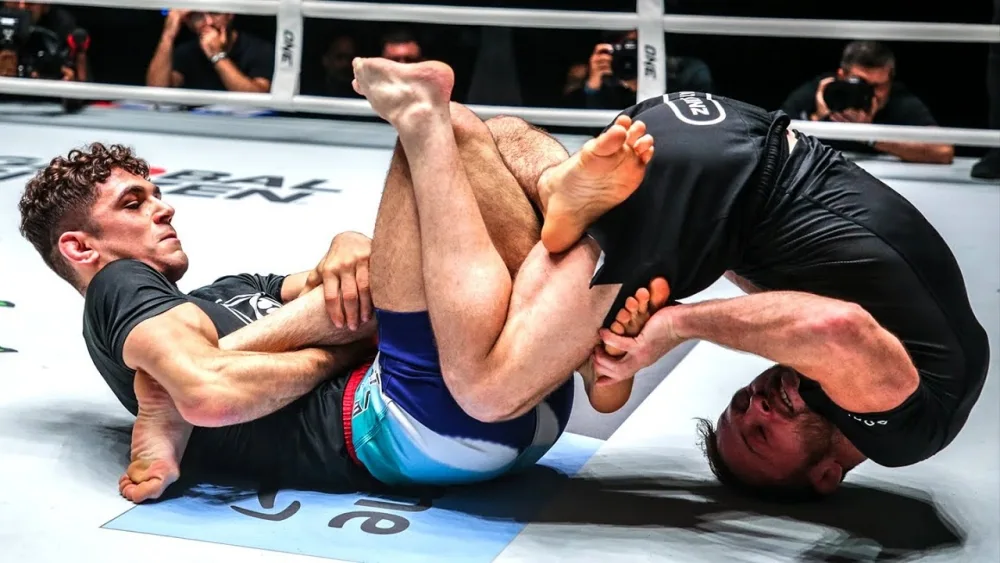
Why Leg Locks Changed BJJ Forever
A decade ago, leg locks were a footnote in competitive BJJ. Today, they're central to modern grappling. Athletes like Gordon Ryan, Garry Tonon, and Craig Jones have proven that mastering leg attacks isn't optional — it's a necessity for any serious competitor.
But leg locks raise legitimate questions: when are they allowed? How do you train them without injury? What's the right progression? This guide answers everything.
Types of Leg Locks — From Ankle Lock to Heel Hook
Ankle Lock
The ankle lock is the most fundamental and accessible leg attack. It targets the ankle ligaments by applying extension pressure combined with rotation. It's the only legal leg attack for white and blue belts in most federations.
- Mechanics: Ankle extension + external or internal foot rotation
- Tap point: Pain in the lateral ligaments or lower leg
- Injury risk: Moderate if applied correctly — avoid explosive rotations
Knee Bar
The kneebar targets the knee joint in hyperextension. Legal from purple belt in IBJJF (Gi) and more broadly in no-gi. Potentially dangerous if applied without control — the tap must come quickly.
- Mechanics: Body used as a lever against knee extension
- Sensation: Pressure in the back of the knee, then ligament pain
- Common mistake: Applying too fast — give your partner time to tap
Heel Hook
The heel hook is the most effective — and most dangerous — leg attack. It targets the knee ligaments (ACL, PCL, MCL) via heel rotation. There are two main variants:
- Outside heel hook: External heel rotation — attacks the inner knee ligaments
- Inside heel hook (reverse heel hook): Internal rotation — targets the ACL and PCL; injury can occur before pain is felt
The inside heel hook is particularly feared because ligament damage can precede pain. The golden rule: tap early, never late.
Toe Hold
The toe hold targets ankle ligaments via a combined rotation. More technical than the ankle lock, it can be applied from various positions. Legal from purple belt in IBJJF.
Leg Lock Legality by Federation
This is the critical section. Getting the legality wrong can result in immediate disqualification.
| Attack | White Belt | Blue Belt | Purple Belt | Brown/Black Belt |
|---|---|---|---|---|
| Straight Ankle Lock | ✅ IBJJF Gi/No-Gi | ✅ All federations | ✅ All federations | ✅ All federations |
| Kneebar | ❌ IBJJF | ❌ IBJJF Gi / ✅ some no-gi | ✅ IBJJF No-Gi / ❌ IBJJF Gi | ✅ IBJJF Gi and No-Gi |
| Toe Hold | ❌ IBJJF | ❌ IBJJF | ✅ IBJJF No-Gi / ❌ IBJJF Gi | ✅ IBJJF Gi and No-Gi |
| Outside Heel Hook | ❌ IBJJF | ❌ IBJJF | ❌ IBJJF | ✅ IBJJF No-Gi only |
| Inside Heel Hook | ❌ IBJJF | ❌ IBJJF | ❌ IBJJF | ❌ IBJJF (all levels) |
ADCC and Modern No-Gi Events
The ADCC allows all leg locks, including inside heel hooks, at all levels. This makes it the benchmark environment for leg lock specialists. Many NAGA and Grappling Industries events offer "submission only" divisions where heel hooks are allowed based on skill level.
How to Train Leg Locks Without Getting Injured
Recommended Progression
- Straight ankle locks — Master the position (outside ashi, 411/saddle) before the attack
- Control positions — Learn outside ashi, inside sankaku, and 50/50 in isolation
- Toe holds and kneebars — Add complementary attacks from the same positions
- Outside heel hook — Introduce gradually with a partner aware of the risks
- Inside heel hook — Only with trusted partners, never full power with beginners
Training Rules
- Tap early: On heel hooks, tap as soon as you feel pressure, not when the pain is strong
- Communicate: Announce attacks when working with new partners
- Never explosive: Heel hook finishes are never explosive in training
- Know the danger zones: Knee rotation beyond 15-20° = immediate tap
Leg Locks in Competition: Strategy
Leg locks aren't a magic solution. Competitors who succeed with leg attacks follow systematic logic:
- Look for natural entries: Guard passing, failed takedowns, scrambles — these moments create opportunities
- Control before attacking: A heel hook attempted without control is easily escaped
- Know the legality perfectly: A DQ on an illegal attack cancels all your efforts
- Have a plan B: If the leg lock is defended, move to a dominant position rather than forcing
Best Resources to Learn Leg Locks
These are the instructionals that defined the leg lock revolution — used by serious competitors worldwide:
- Leglocks: Enter the System — John Danaher — The instructional that changed BJJ. Danaher presents leg locks as a complete system with entries, controls, and finishes from every position. Essential for anyone serious about leg attacks.
- Down Under Leg Locks — Craig Jones — Jones' practical, competition-tested heel hook system. Direct, no-nonsense approach focused on getting the tap in real matches.
- Leg Lock Anthology: 50/50 — Lachlan Giles — Built on his legendary ADCC 2019 absolute performance, this covers the 50/50 position and heel hook entries that made Giles famous overnight.
Disclosure: These are affiliate links. If you purchase through them, we may earn a small commission at no extra cost to you.
Find the Right Competition for Your Leg Lock Level
Depending on your belt level and what's permitted, the relevant events change drastically. A blue belt at IBJJF only has access to ankle locks, while a black belt in no-gi can deploy the full arsenal.
BJJ Championships lists competitions from the IBJJF, ADCC, NAGA, Grappling Industries and more. Filter by federation to find events matching your permitted attacks and plan your season accordingly.